Nationwide · Federal
Federal Government Schemes in Pakistan
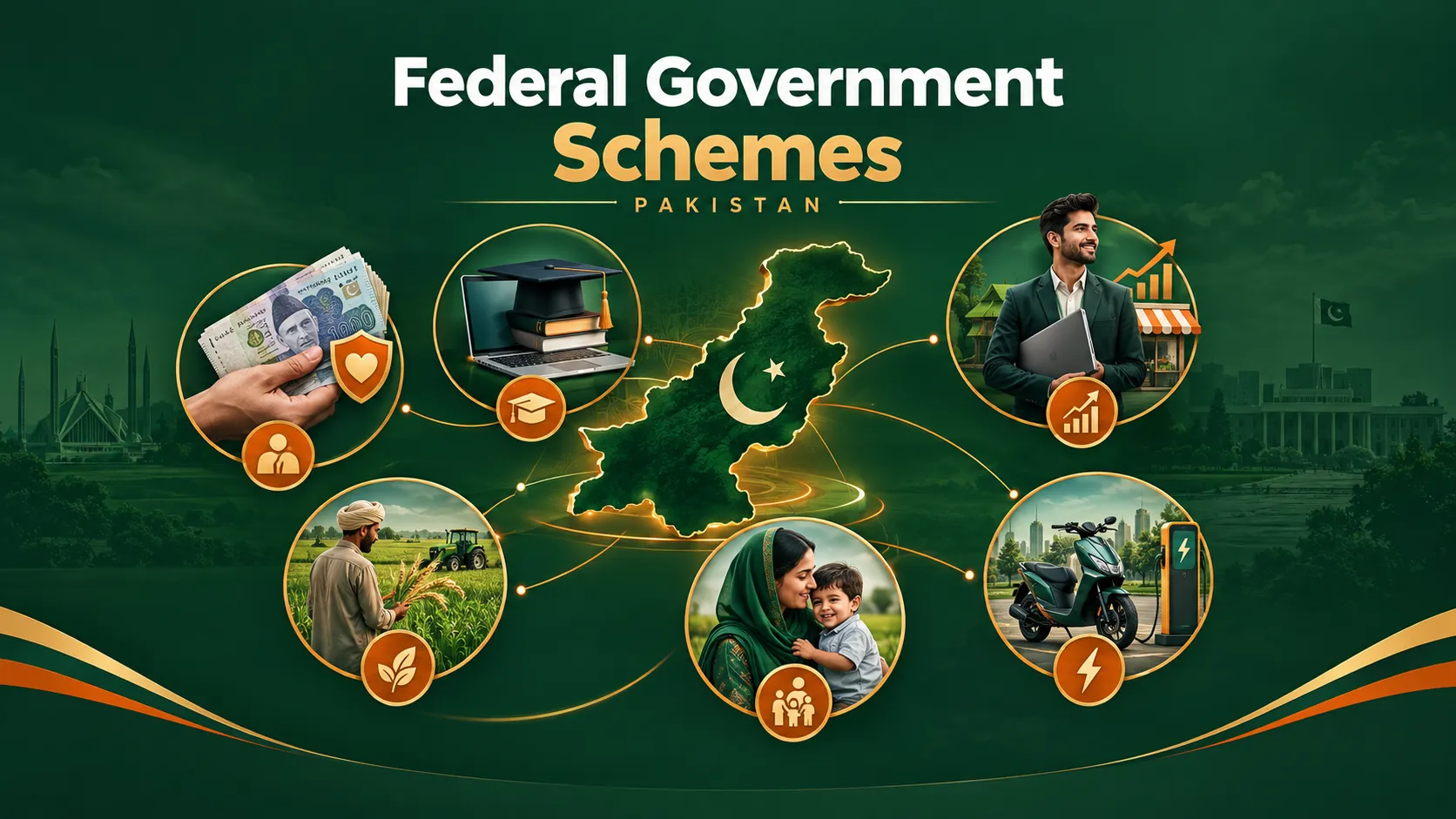
Federal schemes at a glance
Pick the scheme that matches your need first — cash support, business finance, study help, nutrition, transport or fuel — then open its guide for eligibility and application steps.
BISP
Rs. 14,500 quarterly cash stipend (Benazir Kafaalat) for eligible women; register at a BISP Tehsil Office with a valid CNIC and check status free via 8171.
Who it’s for: Eligible women heads of household
Read the guideFederal NSER (National Socio-Economic Registry)
The survey and Proxy Means Test (PMT) score that decide eligibility for BISP and related schemes.
Who it’s for: Households unsure of their PMT score or eligibility status
Read the guidePM Youth Business Loan
Loans up to Rs. 7.5 million across three tiers for new or expanding businesses and farms, applied for online.
Who it’s for: Pakistani residents aged 21 to 45 (18 and above for IT and e-commerce)
Read the guidePM Laptop Scheme
Free laptops for merit-based public university students, run by HEC; merit is a CGPA of 2.80 out of 4.00 or 60% marks under the annual system.
Who it’s for: Public university students with strong academic records
Read the guidePAVE Electric Bike Scheme
Subsidy and interest-free installment financing on electric bikes, rickshaws and loaders, on a fixed vehicle quota.
Who it’s for: Commuters looking for a subsidised electric bike, rickshaw or loader
Read the guideBenazir Nashonuma Program
Nutrition stipend for pregnant women, lactating mothers and children under two; registration is in person at a Nashonuma Centre in a district or tehsil hospital.
Who it’s for: Pregnant women, lactating mothers and children under two in Kafaalat families
Read the guideWaseela-e-Taleem
Benazir Taleemi Wazaif: a quarterly education stipend for school-going children, conditional on at least 70% school attendance each quarter, with girls receiving a higher stipend than boys.
Who it’s for: School-going children of Kafaalat families
Read the guideEhsaas Program
Now operationally merged into BISP; no separate registration is needed and the 8171 portal is the single check-in point for both.
Who it’s for: Anyone who previously registered under the federal Ehsaas Programme
Read the guidePM Fuel Relief Scheme
Rs. 100 per litre petrol relief, with registration by SMS to 9771, for eligible non-commercial vehicles.
Who it’s for: Owners of eligible motorcycles, rickshaws and three-wheelers, and cars up to 800cc
Read the guideWazir-e-Azam Apna Ghar Programme — Rs 10 Million Home Loan at Flat 5% Markup
First-time homeowners ke liye Rs 10 million tak home loan flat 5% markup par — 10 marla tak ghar ya 1,500 sq ft tak flat, kisi bhi bank ya HBFCL se apply karein.
Who it’s for: First-time homeowners
Read the guideCash, education, business and transport in detail
Cash and welfare. BISP is the largest federal cash-transfer scheme. Whether a household qualifies comes down to its NSER score: a PMT score generally needs to fall below 32 for Kafaalat, relaxed to 37 for households with a verified disabled member — ask a local BISP Tehsil Office to check the NSER record directly if unsure. Nashonuma’s stipend was raised by Rs. 500 in February 2026 and registration is only in person, not online. Taleemi Wazaif amounts by class tier vary between sources, so confirm the exact current amount on the scheme’s own page or at bisp.gov.pk.
Education and students. For the PM Laptop Scheme, HEC distributed close to 100,000 laptops in the most recent phase, with a fixed 14% quota reserved for higher-education institutions in Balochistan.
Business, agriculture and transport. Youth business and agriculture loans are applied for through the online portal only, with no physical form required. PAVE runs on a fixed vehicle quota rather than a fixed closing date, so the window closes once allocations run out; applicants with problems can call the official PAVE helpline at 1048.
Which federal scheme should you check first
Need cash support? Start with BISP — it also determines eligibility for Nashonuma and Taleemi Wazaif.
Need business finance? Check the PM Youth Business Loan and compare its three loan tiers.
A student? Check the PM Laptop Scheme’s current merit list before the semester ends, and Waseela-e-Taleem for school-going children.
Mother or young child needing nutrition support? Look at the Benazir Nashonuma Program.
Want an electric bike subsidy? Look at the PAVE Electric Bike Scheme.
Struggling with fuel costs? Look at the PM Fuel Relief Scheme.
Unsure of your eligibility status? Check NSER first — most cash-based schemes trace back to your household’s NSER survey and PMT score.
Independent and unofficial: AwamSchemes is independently owned and operated and is not a government website. It has no affiliation with any government department or scheme, does not accept applications or process payments, and you should confirm dates, amounts and eligibility on the official government portal before you apply.
Each scheme’s own guide has full eligibility steps, current figures, and what to do if something goes wrong.
Frequently asked questions
How many federal government schemes are currently active in Pakistan?
Eight federal schemes were listed as active on this hub: BISP, NSER, the PM Youth Business and Agriculture Loan Scheme, the PM Youth Laptop Scheme, the PAVE Electric Bike Scheme, the Benazir Nashonuma Program, Benazir Taleemi Wazaif, and the Ehsaas Programme (now merged into BISP). Each is run by a different federal body, including BISP, HEC and the PM Youth Programme. This hub also covers the PM Fuel Relief Scheme guide.
How do I know which federal scheme my family qualifies for?
Most cash-based schemes trace back to your household’s NSER survey and PMT score, so checking your BISP status first is the fastest way to find out. Education and loan schemes have separate eligibility rules based on enrollment or age rather than the NSER score.
Is the Ehsaas Programme still separate from BISP?
No. Ehsaas has been administratively absorbed into BISP, and the 8171 portal now handles checks for both, according to bisp.gov.pk. You do not need to register twice if you were already enrolled under Ehsaas.
How much does BISP pay every quarter in 2026?
BISP pays Rs. 14,500 every quarter to eligible women heads of household, an increase confirmed by BISP Chairperson Rubina Khalid in March 2026. Payment status can be checked free by sending your CNIC number to 8171.
What should I do if my BISP payment or laptop scheme status shows an error?
Each scheme’s own guide has a dedicated section on fixing errors, rejected applications and missing merit-list entries. For BISP specifically, complaints can be filed at your nearest Tehsil office or by calling the helpline at 0800-26477.
Do I have to pay any fee to register for a federal scheme?
No. Registration is free for every scheme listed here, including BISP, Nashonuma and Taleemi Wazaif. Anyone asking for a registration fee is not a genuine BISP or PMYP representative, and such cases should be reported to the scheme’s official helpline.
Are federal scheme benefits available in every province?
Yes. The schemes listed here operate nationwide, including Azad Jammu and Kashmir and Gilgit-Baltistan for schemes like BISP and the PM Youth Laptop Scheme. Provincial welfare schemes run separately and are covered on each province’s own pillar page.